



The USDA, Economic Research Service's (ERS) Frontier and Remote area (FAR) code data product categorizes sub-county areas, based on their remoteness from cities and towns. The data provide a set of delineations that capture the varying degrees of remoteness experienced throughout the country, allowing users to choose the definition that best suits their specific needs.
This page provides basic definitions, as well as tables and maps that summarize the data. It focuses on the newest ZIP Code version of the 2020 FAR codes. For more details on the background and creation of the FAR codes, see the Documentation.
Definitions
- Urban area: A statistical unit that uses population density and contiguity requirements to capture the built environment of an urban location.
- Rural area: Any location outside of an urban area.
- FAR Level 1: Rural areas and urban areas of up to 50,000 people may be classified as frontier and remote. Level 1 areas are 60 minutes or more from an urban area of 50,000 or more people.
- FAR Level 2: Rural areas and urban areas up to 25,000 people may be classified as frontier and remote. Level 2 areas are 45 minutes or more from an urban area of 25,000–49,999 people, and 60 minutes or more from an urban area of 50,000 or more people.
- FAR Level 3: Rural areas and urban areas up to 10,000 people may be classified as frontier and remote. Level 3 areas are 30 minutes or more from an urban area of 10,000–24,999 people, 45 minutes or more from an urban area of 25,000–49,999 people, and 60 minutes or more from an urban area of 50,000 or more people.
- FAR Level 4: Rural areas may be classified as frontier and remote. Level 4 areas are 15 minutes or more from an urban area of fewer than 10,000 people, 30 minutes or more from an urban area of 10,000–24,999 people, 45 minutes or more from an urban area of 25,000–49,999 people, and 60 minutes or more from an urban area of 50,000 or more people.
Frontier and Remote areas of the United States
The FAR code levels indicate increasing degrees of remoteness. By design, FAR Level 1 is relatively expansive, while FAR Level 4 is more restrictive. They are nested, so the Level 2 definition adds criteria to the Level 1 definition, the Level 3 definition adds criteria to the Level 2 definition, and the Level 4 definition adds criteria to the Level 3 definition. Therefore, places that are FAR Level 2 are also FAR Level 1, and so on. Additionally, this means that residents in places that are not FAR Level 1 are never considered frontier or remote.
That FAR Level 1 is more expansive than the other FAR levels makes sense from an urban hierarchy perspective, as well. This is because a greater proportion of the people and land of the United States is over an hour from an urban area with high order goods and services (e.g., advanced medical procedures, regional airports) than is 15 minutes away from an urban area with low order goods and services (e.g., grocery stores, gas stations).
The distribution of the U.S. population and land area across the 2020 FAR Codes at the ZIP-Code-level is available in the table below. The disparity between the proportions of population and land area is quite large. Nearly 12.8 million people, or 3.9 percent of the U.S. population, lived in FAR Level 1 ZIP Codes. But these people resided on nearly 1.9 million square miles of land, or 52.7 percent of U.S. land area. This makes the FAR Level 1 share of land more than 13 times its population share.
| ZIP Codes | Population | Land area | ||||
|---|---|---|---|---|---|---|
| Count | Percent | People | Percent | Square miles | Percent | |
| U.S. total | 32,158 | 100.0 | 329,366,519 | 100.0 | 3,599,629 | 100.0 |
| FAR Level 1 | 6,090 | 18.9 | 12,781,856 | 3.9 | 1,896,009 | 52.7 |
| FAR Level 2 | 4,978 | 15.5 | 8,626,607 | 2.6 | 1,725,306 | 47.9 |
| FAR Level 3 | 3,757 | 11.7 | 4,944,880 | 1.5 | 1,545,843 | 42.9 |
| FAR Level 4 | 3,411 | 10.6 | 3,643,851 | 1.1 | 1,440,266 | 40.0 |
| Note: A ZIP Code area was classified as frontier and remote (FAR) if the majority of its grid-estimated population was classified as FAR. The FAR codes are nested, with Level 1 being the most expansive category and Level 4 being the most restrictive category. This means that the percentages and counts above should not be added across levels. Land area refers to the total area of the United States, including both land and water. Source: USDA, Economic Research Service, 2020 Frontier and Remote Area Codes. |
||||||
As expected, the proportion of the population living in FAR areas and the proportion of the land considered FAR decreases as the FAR level increases. More than 3.6 million U.S. residents (1.1 percent) lived in FAR Level 4 locations, which is a little more than a quarter of the FAR Level 1 population. They lived on more than 1.4 million square miles (40 percent) of land, which is about three-quarters of the FAR Level 1 land area.
The map below illustrates the land classified as the four FAR levels in the vintage 2020 data. Light grey represents land that is not classified as FAR at any level. Light green represents land that is only classified as FAR Level 1, the least restrictive definition of geographic isolation. While dark green represents land that is classified as FAR Level 4 (and, subsequently, Levels 3, 2, and 1), the most restrictive definition of geographic isolation. The map overlaps all four FAR level maps to illustrate the different geographic extents of each level. Individual maps of each FAR level are available as a download on the Overview page.
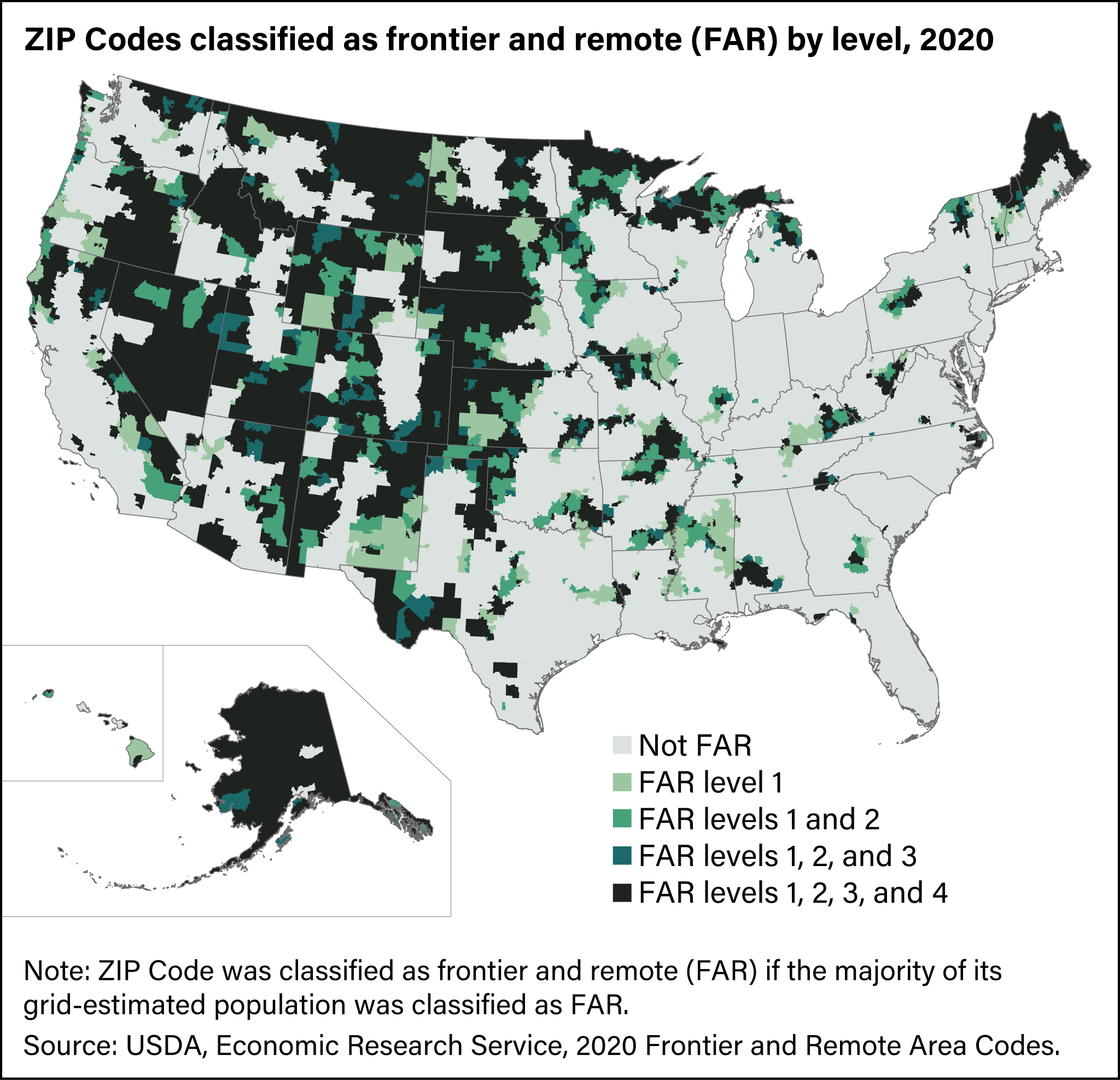
Much of the frontier and remote land in the United States is located the Great Plains, Mountain West, and Alaska. However, several smaller islands of frontier and remote land are located throughout the country, including portions of the Appalachian and Ozark Mountains and northern parts of New England and the Upper Midwest. The map has a slightly “patchy” quality to it because each FAR level adds a travel time to smaller urban areas to indicate an increasing level of geographic isolation. The urban areas with intermediate order goods and services and the ZIP Codes within their travel time band appear as lighter shades of green surrounded by the dark green FAR Level 4 land. These areas are generally located between the urban areas with high order goods and services, creating the “patchy” quality.
Regional and State variation in frontier and remote areas
The map in the previous section indicates that there is great regional variation in the share of the population and land area across the United States. The chart below shows the distribution of population and land area across FAR code levels by Region for the vintage 2020 data. The bars in the chart are ordered from the largest to smallest shares, so Regions may appear in different orders for each group.
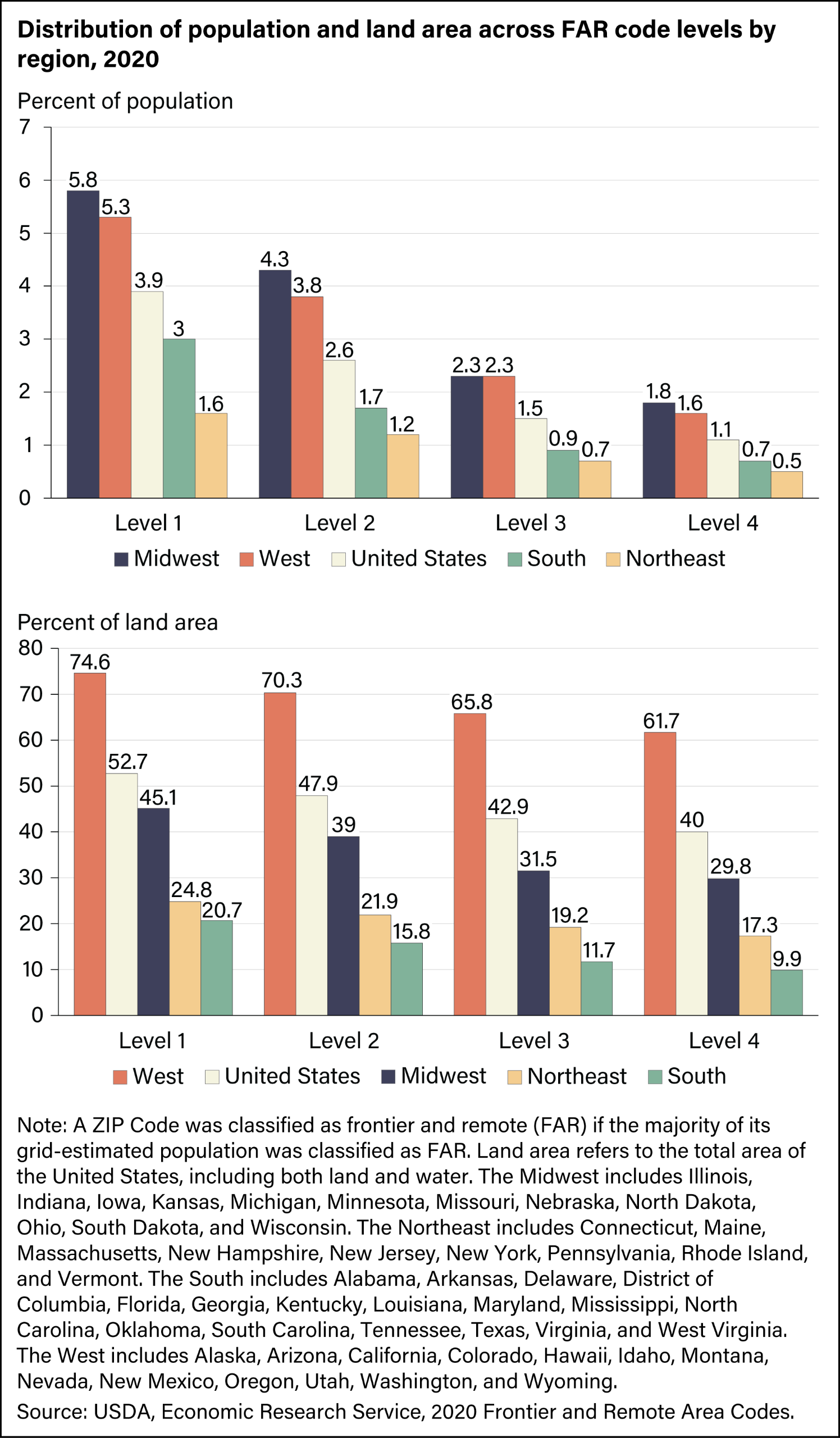
The Midwest has the highest proportion of residents living in FAR Level 1 areas, 5.8 percent. This is true for the other three FAR levels as well. The West has the second largest population share in frontier and remote areas for all FAR codes, while the Northeast has the smallest proportion. In fact, the Midwest has a larger share of residents living in FAR Level 4 areas (1.8 percent) than the Northeast has in FAR Level 1 areas (1.6 percent).
The five States with the highest frontier and remote population shares are all located in the Midwest and West. Wyoming, a Western State, has a much larger proportion of its population living in FAR Level 1 ZIP Codes than the rest of the States at 56.1 percent. The rest of the top 5 have more similar FAR Level 1 population shares (between 33.6 percent and 29.6 percent): Montana, South Dakota, Alaska, and North Dakota. The Northeast Region has several States with no FAR Level 1 land or residents: Connecticut, Delaware, New Jersey, and Washington, DC. Ohio, a Midwestern State, also does not have any FAR Level 1 land or residents.
The West has by far the largest share of land classified as frontier and remote, ranging between 74.6 percent for FAR Level 1 and 61.7 percent for FAR Level 4. The Midwest is a distant second, with only 45.1 percent of land classified as FAR Level 1 and 29.8 percent classified as FAR Level 4. The disparity between the West and the rest of the Regions is so stark that the United States, overall, has a higher share of frontier and remote land than the Midwest, Northeast, and South. The South has the least amount of land classified as frontier and remote for all FAR levels.
The top four States with the highest frontier and remote population shares are all part of the West. Alaska has the largest share of FAR Level 1 land in the United States and is nearly completely frontier and remote at 97.4 percent. The other 3 top States are between 81.3 percent and 83.4 percent frontier and remote: Nevada, Wyoming, and Hawaii. South Dakota, a Midwestern State, has the fifth highest share of land classified as FAR Level 1, at 79 percent. The State-level information presented here is available as summary tables in the File Downloads section of the Overview page.